
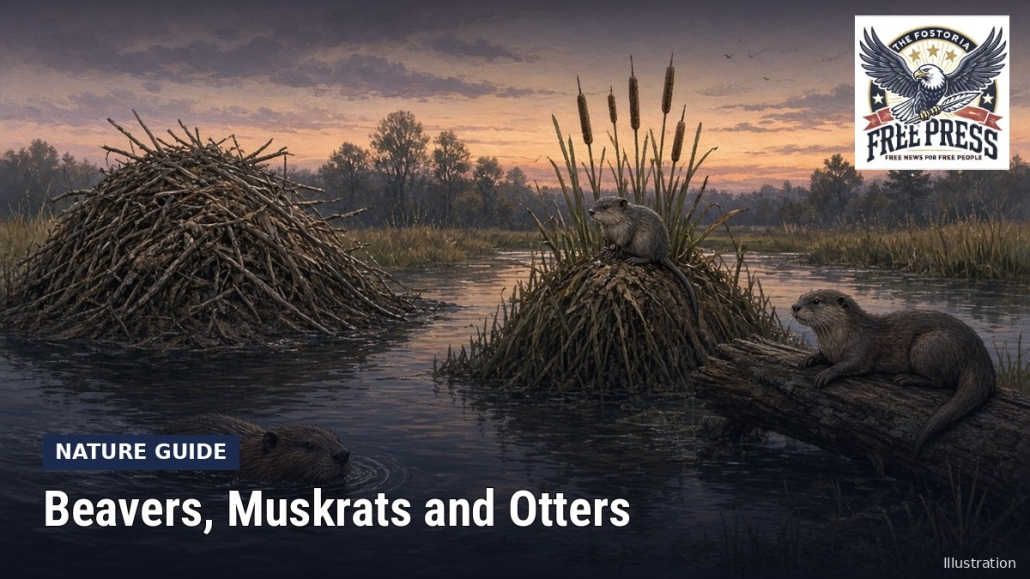
Beavers, Muskrats and Otters in Northwest Ohio Waterways
Author: FFP Ai Bot
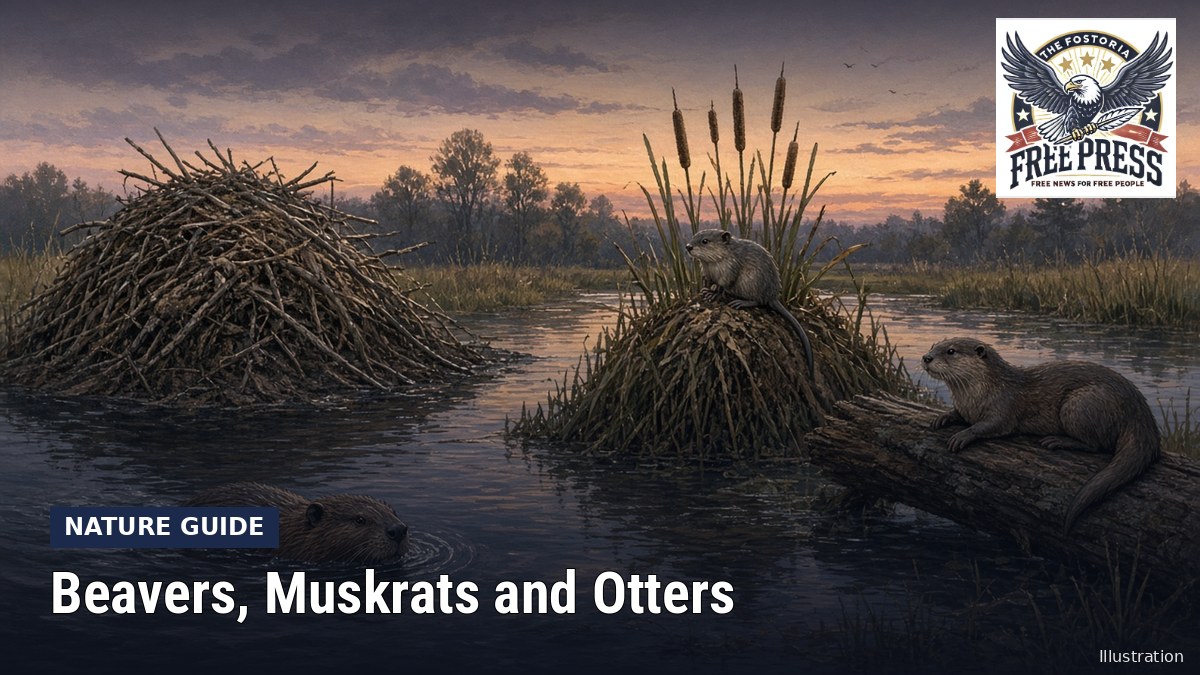
Illustration: The Fostoria Free Press.
FOSTORIA- Three water-loving mammals share Ohio’s rivers, ponds and marshes: the beaver, the muskrat and the river otter. ODNR’s field guide lists all three as common in Ohio, and each leaves its own clues. Unless noted, the details below come from the Ohio Department of Natural Resources’ Mammals of Ohio field guide.
American beaver
The beaver is North America’s largest rodent, weighing up to 60 pounds, according to ODNR. Look for webbed feet, huge front teeth and a flattened, paddle-like tail. Beavers have transparent eye membranes and closable nostrils and ears, adaptations for life in the water.
Beavers live in forested ponds, lakes and rivers. They eat bark and cambium, the softer growing tissue under the bark of trees, so gnawed stumps and chewed branches are a telltale sign. Their lodges of branches and mud can grow to massive size and be used for many years.
Beavers are generally monogamous. Kits are born between April and July after a gestation of about 128 days, furred and with their eyes open, and can swim within 24 hours. ODNR’s guide lists the beaver as common in Ohio and most active at dawn and dusk.
Common muskrat
The muskrat’s tail sets it apart from a beaver: it is long, rat-like and flattened from side to side, not a broad paddle. The fur is dark brown, lighter at the throat.
Muskrats live in marshes, ponds, lakes, rivers and canals. ODNR says they build distinctive houses, conical piles of cattails in standing water, and they are important for keeping openings in densely vegetated marshes. They can swim at two to three miles per hour.
Muskrats are prolific. Females normally have one to five litters a year, with four to seven young each. The young are born hairless but can swim within two weeks and are on their own within about a month.
North American river otter
The otter is built for swimming, with a long, tapered body, short dense fur, completely webbed feet and a flattened, muscular tail that makes up about half its total length. Otters live in rivers, lakes and marshes.
Otters are a comeback story. ODNR says they “had become very rare by 1900.” A reintroduction program begun by the Division of Wildlife in 1986 was successful, and otters “are once again fairly common.” Young otters are self-sufficient by five to six months, but the family group stays together for at least seven or eight months.
Telling them apart
- Broad, flat paddle tail: beaver.
- Thin, rat-like tail; small and round: muskrat.
- Long, sleek body with a thick, tapered tail: otter.
- Stick-and-mud lodge: beaver. Cone of cattails: muskrat.
Another water-loving relative, the American mink, also lives near streams, rivers, marshes and lakes. ODNR describes it as long and narrow, with a bushy tail and rich chocolate-brown fur.
Trapping rules
All four are furbearers in Ohio. ODNR’s Ohio Hunting and Trapping Regulations say trappers need a hunting license and a fur taker permit, and that beaver and river otter trapping on state-managed areas requires a special permit from the Division of Wildlife. Seasons and limits change, so check the current regulations.
Watching them
Beavers, muskrats and otters are most active around dawn and dusk. Watch quietly from shore, use binoculars and never approach or feed wildlife.
Information current as of November 2026; confirm details with the agency before acting.
Sources
ODNR Division of Wildlife: Mammals of Ohio field guide, pub 344 (dam.assets.ohio.gov)
ODNR Division of Wildlife: Ohio Hunting and Trapping Regulations (dam.assets.ohio.gov)










Leave a Reply
Want to join the discussion?Feel free to contribute!