
FOSTORIA | Up Perry Street: The Daily Times, Marble Works and Streetcar Tracks of the Early 1900s
Author: FFP Ai Bot
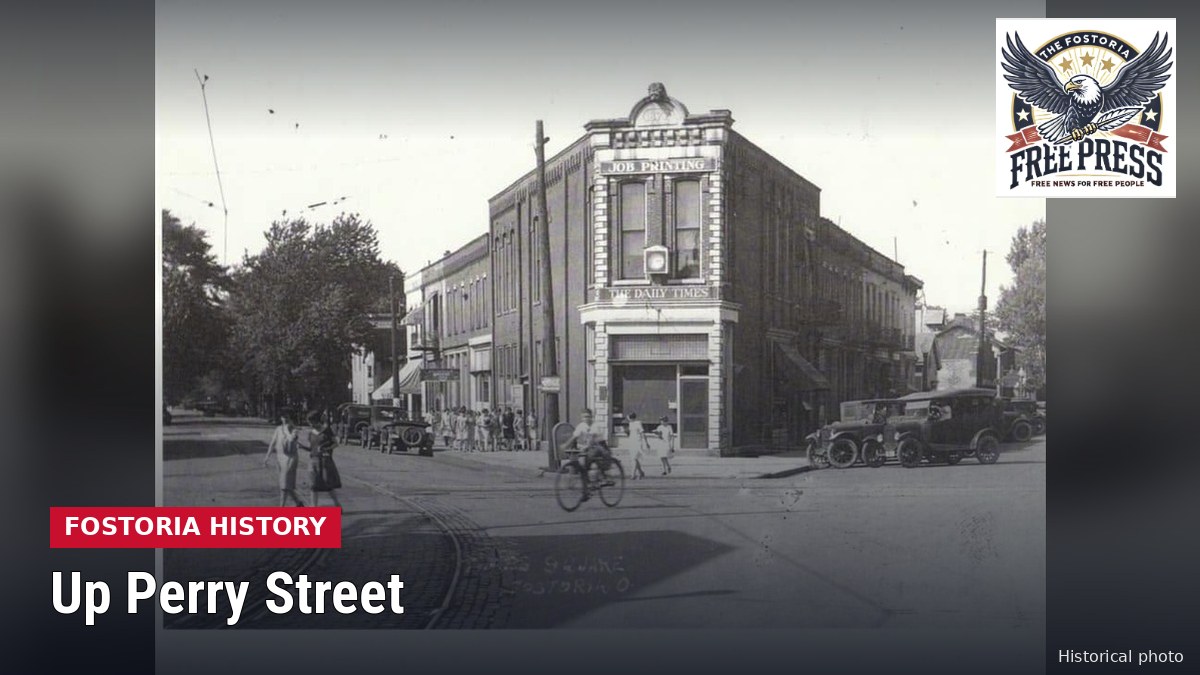
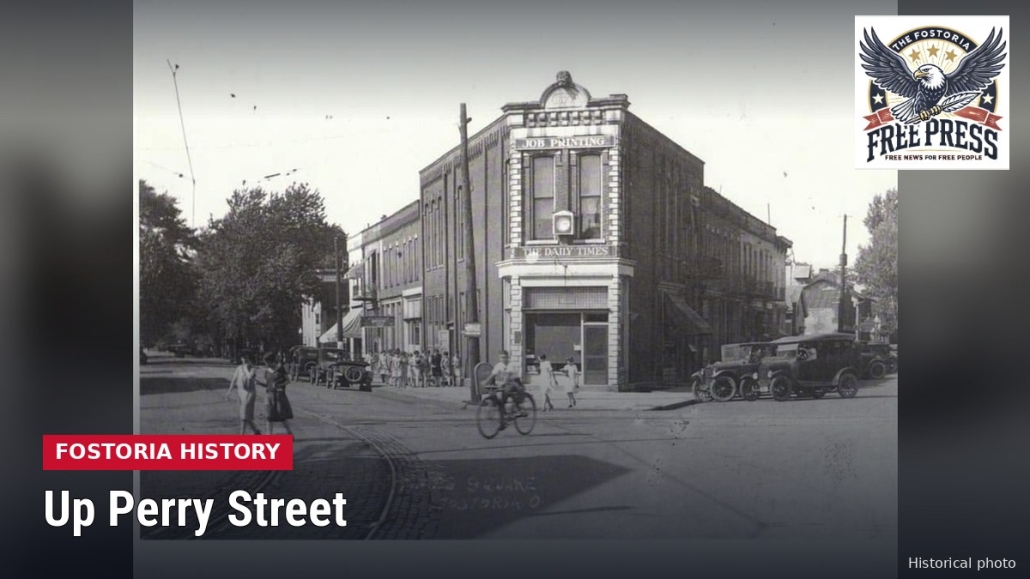
The Daily Times building at Main and Perry, 1920s
FOSTORIA — Perry Street starts at a point. It splits off Main Street at an angle near Sandusky Street and runs north past Fremont toward High Street, and for generations it was one of the city’s busiest streets, lined with shops, a newspaper office, a hotel, a photographer’s studio and the tracks of an electric interurban.
This installment of our local history series takes a walk up Perry Street as early photographs and postcards show it, guided by a pair of 1978 Fostoria Area Historical Society columns that traced the street block by block.
Quick timeline
| Year | What happened |
|---|---|
| 1889 | H. L. Porter starts a dye works and dry cleaning business on Perry Street. It stays in the family for 74 years. |
| 1901 | The first leg of the Toledo, Fostoria & Findlay interurban opens between Fostoria and Findlay. |
| 1909-1910 | A city directory lists the Poley Marble Works at 101 Perry and the Fostoria Times at 102. |
| About 1916 | The Hale Building is presumably razed to make way for the McLean Library, as it was originally known. |
| 1920s | The Daily Times building at Main and Perry is photographed with Model T-era cars. |
| About 1932 | Like most electric lines in the area, Fostoria interurban service comes to an end. |
The Times at the corner
The opening view on this page shows the corner where Perry meets Main. A narrow brick building with an ornate parapet carries two signs: “JOB PRINTING” at the top and “THE DAILY TIMES” over the door. Streetcar rails curve across the brick pavement, a boy pedals past on a bicycle, and Model T-era cars are parked at the curb.
According to the historical society, the corner was called Times Square because The Fostoria Times, one of the city’s two newspapers, occupied this building. Before that, it housed the W. D. Robbins Marble Shop. After The Times was bought by The Review, the building was sold and eventually torn down for a gas station. Our story on Main, Perry and Sandusky at the turn of the century tells more about the square.
Monuments, barbers and a dye works
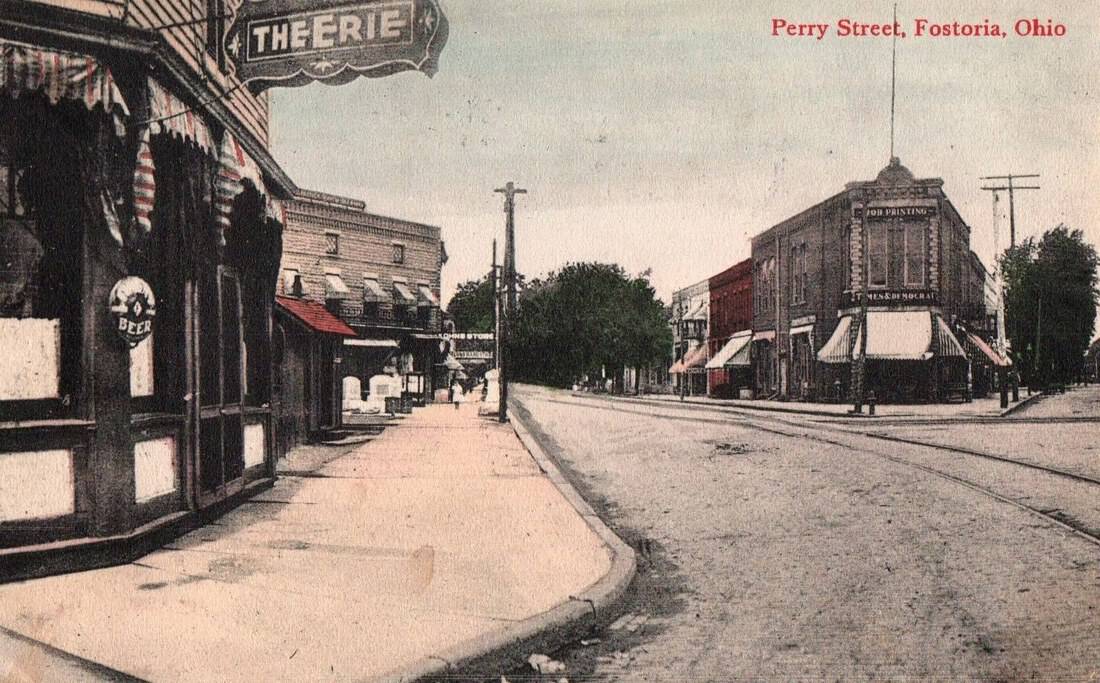
“Perry Street, Fostoria, Ohio,” postcard, early 1900s
This colored postcard looks up Perry Street from near the split. On the left hangs a sign reading “THE ERIE,” above a “BEER” sign in a window. Beyond, white stone shapes stand on the sidewalk outside a shop. On the right, the Times building wears a long striped awning, with “JOB PRINTING” across the top and a second sign that appears to read “& Democrat.” Streetcar tracks run up the middle of the street.
The white stones appear to fit the record. A partial list of Perry Street businesses, drawn partly from a 1909-10 city directory and printed by the historical society, puts the Poley Marble Works at 101 Perry. Joseph Poley built that building, later known as the Dehaber Building, and ran a monument business there for many years. The list also includes H. E. Kohn’s dry goods store at 103-105, a second-hand store, a painting contractor, George M. Fink’s electrical supplies, a barber, the Fostoria Furnace Co., the Ohio and Western Lime Co. and I. W. Dicken’s photographic studio at 121.
One of the longest-lived businesses was Porter’s Dye Works at 113. H. L. Porter started it in 1889 in a frame building next to his house, and the society reported in 1978 that it had stayed in the family and in the same place for 74 years before passing to a longtime employee.
Streetcars on the bricks
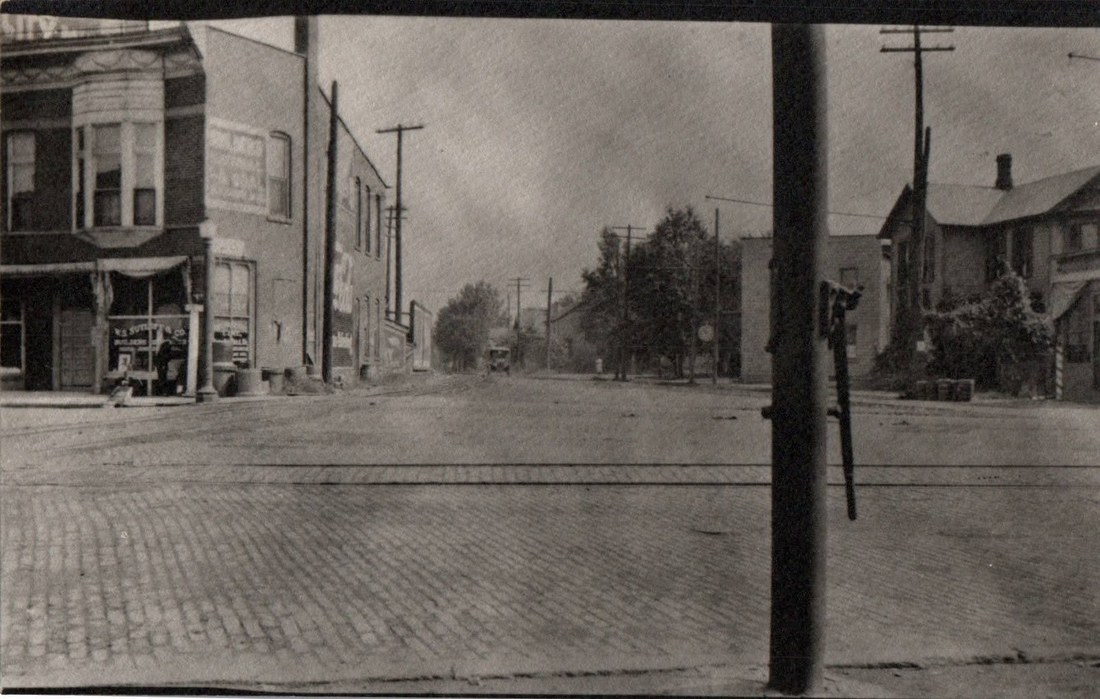
Looking east across Perry Street, early 1900s
This undated photo looks east across a wide brick street, with a set of streetcar rails, a corner store with a striped awning and a row of houses beyond. It has been described as a view on Perry Street, but we could not confirm the exact spot. The brick paving, the rails and the absence of automobiles suggest the 1900s or 1910s.
The historical society identified the Perry Street tracks as those of the Toledo, Fostoria & Findlay, an electric interurban whose first leg, between Fostoria and Findlay, opened in 1901. Like most such lines, Fostoria’s interurbans faded by about 1932 as automobiles and trucks took their business. A society column says that J. W. McDonel, who lived at 230 Perry, was connected with the interurban business and ran the McDonel Clothing Store with his brother James.
Up the street
Farther north, the whole east side of Perry from Fremont to High was once known as the “McDonel Block.” The society noted that the McDonel Apartments of the old photos were still standing in 1978 as the Rowan Apartments. More early apartment buildings and homes appear in our story on Fostoria homes and streets on early postcards. The Perry Street House, a hotel, was a landmark nearby for many years, and a neighboring McDonel family house was later sold to the Commercial Bank as part of the site for its new bank.
Near the library site, the column says, there was once a livery stable and then the Hale Building, which was presumably taken down around 1916 for the McLean Library, as it was originally known. Today the Kaubisch Public Library on Perry Street holds the city’s local history collection, a fitting keeper of the street’s memories. Fire insurance maps at the Library of Congress also show Perry Street lot by lot.
Do you remember Porter’s Dye Works, the Perry Street House or the interurban? We would like to hear from you. For more on the railroads that crossed nearby, see the LE&W depot and the Iron Triangle.
Photo note: Photographs and images published before 1931 are in the public domain in the United States. Historical images in this article are shared for educational and historical purposes.
Sources
- Fostoria Area Historical Society, Perry St.: How a Major Thoroughfare Used to Appear (Sept. 28, 1978): https://www.fostoriamuseum.org/perry-st-how-a-major-throughfare-used-to-appear/
- Fostoria Area Historical Society, Journey Down Perry St. Continues (Oct. 5, 1978): https://www.fostoriamuseum.org/journey-down-perry-st-continues/
- Library of Congress, Sanborn Fire Insurance Map, Fostoria, Ohio, 1896: https://www.loc.gov/item/sanborn06698_003/
- Fostoria Area Historical Society, Electric Trolley Era Still Pleasant Memory for Some (May 4, 1977): https://www.fostoriamuseum.org/electric-trolley-era-still-pleasant-memory-for-some/
- Kaubisch Public Library, Local History: https://www.fostoria.lib.oh.us/findinfo/localhistory






Leave a Reply
Want to join the discussion?Feel free to contribute!