
OHIO | Top 10 Most Haunted Places in Ohio (Allegedly)
Author: FFP Ai Bot
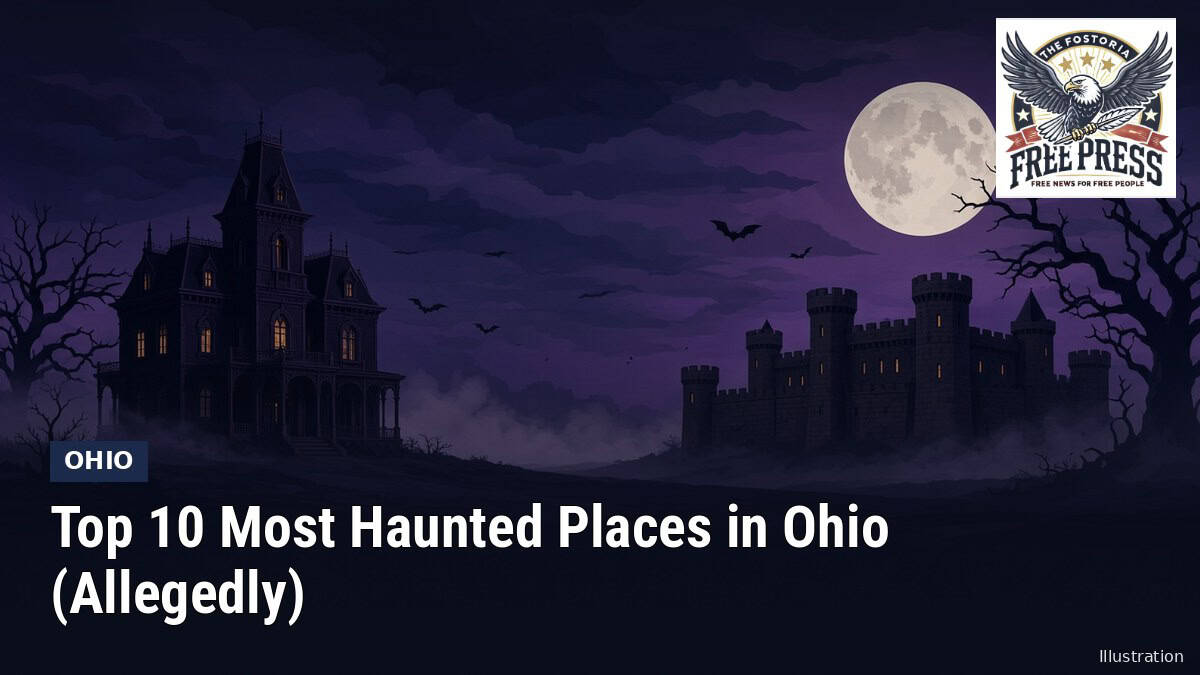
Illustration of a generic haunted mansion and prison. This is not a photo of any place on this list. Illustration: The Fostoria Free Press.
OHIO- Halloween is one week away, and Ohio has no shortage of places where people swear something is still walking the halls. Inspired by author Chris Woodyard’s long-running “Haunted Ohio” book series, which has collected the state’s ghost stories for decades, The Fostoria Free Press put together 10 of the Buckeye State’s most famous allegedly haunted places, including two close to home in Toledo and Bowling Green.
Every story below is a legend or a reported experience, not a proven fact. We checked each place against news reports, historical societies and the sites’ own official pages, and paired each tale with a piece of real history. Where a story has been debunked, we say so. Where a site offers official tours, we list them. Please respect private property and closed buildings, and remember that many of these places were homes, hospitals and poorhouses for real people.
1. The Prison That Shawshank Made Famous – Ohio State Reformatory
Mansfield, Richland County
The Ohio State Reformatory’s own paranormal team calls it one of the most famous haunted prisons in America. According to the staff, the ghost of Helen Glattke, wife of longtime superintendent Arthur Glattke, is reportedly noticed as the smell of the rose water perfume she made, while Arthur is said to announce himself with the scent of cherry pipe tobacco. Visitors also report smoke smells in the West Attic and a lone wooden chair that allegedly moves on its own.
The real history: The prison took its first inmates in 1896, closed in 1990 and was the main filming location for “The Shawshank Redemption” in 1993. Helen Glattke died in 1950 after a handgun fell from a closet shelf and went off, and Arthur died of a heart attack in his office in 1959.
Visiting: The Ohio State Reformatory Preservation Society offers daytime tours, ghost walks and public ghost hunts on select dates. Details at mrps.org.
2. The Castle on Franklin Boulevard – Franklin Castle
Cleveland (Ohio City), Cuyahoga County
For decades, Franklin Castle has been called Cleveland’s most haunted house, with stories of a woman in black in the tower windows, crying children and hidden rooms. According to legend, original owner Hannes Tiedemann was a murderer, but historians say that part is false: the Encyclopedia of Cleveland History notes the haunted-house stories do not seem to predate 1965, and the house’s historian told Cleveland Magazine the murder tales were invented by a self-described medium living there around 1980.
The real history: The stone Queen Anne mansion at 4308 Franklin Blvd. was built in 1881 to 1883 for Tiedemann, a German immigrant grocer and banker. The family did suffer real grief, losing three infant children to disease between 1863 and 1873 and daughter Emma in 1881, before the house was finished.
Visiting: Franklin Castle is a private residence and is not open for public tours.
3. The Concert Hall Built on a Potter’s Field – Cincinnati Music Hall
Cincinnati (Over-the-Rhine), Hamilton County
Staff and visitors at Music Hall have reported footsteps in an empty auditorium, whispers in Corbett Tower and unexplained music. The late Cincinnati Pops conductor Erich Kunzel, who worked there late into the night, said he believed the spirits in the building were “basically quite friendly,” according to the Friends of Music Hall.
The real history: Music Hall, a National Historic Landmark, was built over part of an old potter’s field used for paupers and unidentified dead. Human remains have turned up during construction and renovation work in 1876, 1927, 1988 and again in 2016.
Visiting: Friends of Music Hall holds Ghost Tours of Music Hall each fall. The Oct. 30, 2026, tours at 7 and 9 PM are listed as sold out on the official Cincinnati Arts ticket page.
4. The Nuns of Collingwood Boulevard – Collingwood Arts Center
Toledo, Lucas County
The Collingwood Arts Center calls itself one of the most haunted locations in Ohio, and it has appeared in the “Haunted Ohio” books and on the TV show “Ghost Hunters” in 2022. According to legend, the ghost of a nun is seen in the third row of the theater balcony, another is said to sit sewing in the attic and smile before vanishing, and a “dark man” reportedly drifts near the basement stairs.
The real history: The Flemish Gothic building at 2413 Collingwood Blvd. was designed by Toledo architect E.O. Fallis as a convent and school for the Ursuline Order. It later housed Mary Manse College and St. Ursula Academy before the arts center bought it in 1985.
Visiting: The center offers public and private ghost hunts and tours by request, plus a Haunted Collingwood historic tour on Saturday, Oct. 24, 2026. Details at collingwoodartscenter.org.
5. The Old County Poor Farm – Wood County Museum
Bowling Green, Wood County
Chris Woodyard’s “Haunted Ohio” tells of several reported spirits at the former Wood County Infirmary, including an elderly woman in a white nightgown nicknamed “Agnes” and the sound of dishes rattling in an empty dining room. One story from a late-1980s restoration says a worker finished varnishing a floor, left for the night and returned to find a single set of small footprints in the middle of it.
The real history: The building served as the Wood County poor farm and infirmary from 1869 to 1971, and more than 350 people are buried in its paupers’ cemetery. Museum leaders have said the ghost stories only appeared after it became a museum, and the historical society does not allow paranormal investigations, asking visitors to focus on the real people who lived there.
Visiting: The museum at 13660 County Home Road offers self-guided tours of the infirmary, asylum, pest house and cemetery. Details at woodcountyhistory.org.
6. The Asylum on the Hill – The Ridges
Athens, Athens County
The former Athens Lunatic Asylum is a fixture of Ohio ghost lore, with tales of patients’ spirits in the empty wards. Its most famous story is the outline of a body on a concrete floor, left by patient Margaret Schilling, who went missing in December 1978 and was found in a closed ward in January 1979. A 2007 forensic study found the mark came from natural decomposition, not anything supernatural, though it has never fully faded.
The real history: The asylum opened in 1874 under the Kirkbride plan, which used light, fresh air and landscaped grounds as part of treatment. It held about 1,800 patients by the 1950s, was transferred to Ohio University in 1988 and saw its last patients leave in 1993.
Visiting: Ohio University lists walking tours by the Southeast Ohio History Center, hiking trails and self-guided tours on its official Ridges page. Closed buildings are off limits.
7. The Mansion of the Abolitionist – Prospect Place
Trinway, Muskingum County
According to local legend, Prospect Place is haunted by a little girl who fell from a balcony, a bounty hunter said to have been hanged in the barn and members of the Adams family who built it. Paranormal groups have investigated the mansion for years, and its owners invite visitors to decide for themselves.
The real history: George W. Adams built the mansion in 1856, saw it burn the night before his family was to move in and rebuilt it on the same foundation. Adams was an abolitionist active in the Underground Railroad, though the site’s own historians say no secret tunnel has ever been found in the basement.
Visiting: The nonprofit G.W. Adams Educational Center offers free daylight tours on weekends from March through November, plus flashlight tours and public ghost hunts. Details at historicprospectplace.org.
8. The Lady in Blue – The Buxton Inn
Granville, Licking County
The Buxton Inn has collected ghost stories for generations. Former owner Ethel “Bonnie” Bounell, the “Lady in Blue,” is reportedly seen in Room 9, and guests have told of a woman appearing at the foot of the bed. There are also tales of a phantom cat, named for the inn’s real cat Major Buxton, slipping around corners.
The real history: The inn dates to 1812, when it was established by Orrin Granger. Major Horton Buxton bought it in 1865 and gave it its name, and Bounell owned it from 1934 until her death in 1960.
Visiting: The inn is open as a restaurant and lodging at 313 E. Broadway, Granville. Details at buxtoninn.com.
9. The Red Lantern in the Woods – Squire’s Castle
Willoughby Hills, Lake County
According to legend, Mrs. Squire wanders this stone “castle” in the woods with a red lantern after dying in a fall on the basement stairs. It is one of the best-known ghost stories in Northeast Ohio, but Woodyard herself pointed out in “Haunted Ohio III” that the tale does not hold up: records show Mrs. Squire died in 1927, two years after the property was sold to the park system.
The real history: Standard Oil executive Feargus B. Squire built the stone building in the 1890s as the gatehouse for a country estate whose main house was never built. It is now an empty shell inside Cleveland Metroparks’ North Chagrin Reservation.
Visiting: The site is open during park hours. Details from Cleveland Metroparks.
10. The Ghosts of the Oval – The Ohio State University
Columbus, Franklin County
Ohio State’s campus is full of ghost stories, many collected by The Lantern student newspaper and university archives. According to legend, a widow haunts Mirror Lake and Pomerene Hall, a former president is seen reading by lamplight in the Orton Hall bell tower, and two students out past curfew in Hayes Hall were let in by a bearded man they later recognized in a portrait of President Rutherford B. Hayes. Building staff have reported doors that lock and unlock on their own.
The real history: Professor Frederick Converse Clarke died by suicide near Mirror Lake in 1903, and Pomerene Hall was later built on the same hill. Hayes Hall opened in 1893, two weeks after Hayes died, and briefly served as student housing from 1915 to 1920.
Visiting: The campus grounds are public, but residence halls and many buildings are restricted to students and staff.
Believe it or not
Whether these stories are true is up to you. What is true is that every place on this list has a real history worth knowing, and several, like the Wood County Museum, the Ohio State Reformatory and Prospect Place, are kept alive by volunteers and nonprofits that depend on visitors. If you go ghost hunting this Halloween, take a flashlight, follow the rules and never trespass.
If you or someone you know is struggling, call or text 988 to reach the 988 Suicide and Crisis Lifeline, available 24 hours a day.
Sources:
The Ohio State Reformatory Preservation Society, mrps.org, Paranormal Programs
WOSU Public Media / Ideastream, “Ghost stories of ‘The Shawshank Redemption’ prison live on in Mansfield,” Oct. 31, 2025
Encyclopedia of Cleveland History, Case Western Reserve University, “Tiedemann House”
Cleveland Historical, “Tiedemann House: a.k.a. Franklin Castle” and “Tiedemann Family Monument”
Cleveland Magazine, “CLE Myths: Haunted Franklin Castle”
Friends of Music Hall, “Is Music Hall Haunted?” and “Bones Discovered Under Music Hall”
USA Today / Cincinnati Enquirer, “Bodies under Cincy Music Hall date to at least 1928,” May 1, 2016
Cincinnati Arts Association, Ghost Tours of Music Hall ticket listing
Collingwood Arts Center, collingwoodartscenter.org, and Eventbrite listing for Haunted Collingwood: Historic Tour Edition
WTOL 11, “Is the Collingwood Arts Center the most haunted building in Toledo?”
BG Independent News, “Paranormal policy spelled out – and not on Ouija board”
BG Falcon Media, “‘Infirmary tours’ return for fall”
Wood County Museum, woodcountyhistory.org
Ohio University, “History of The Ridges” and “Visit The Ridges”
PreservationWorks, “Margaret Schilling’s Trace at The Ridges,” Feb. 22, 2020
Historic Prospect Place, historicprospectplace.org
Ghost Research Society, Prospect Place investigation notes
Buxton Inn, “The Lady in Blue and Major Buxton: Legends and Lore of the Buxton Inn” and History page
Cleveland Magazine, “Park Shadows,” June 23, 2004
Encyclopedia of Cleveland History, “Squire’s Castle”
The Lantern, “New encounters bring Ohio State hauntings to light,” Oct. 31, 2014
Chris Woodyard, “Haunted Ohio” book series (inspiration; no text reproduced)









Leave a Reply
Want to join the discussion?Feel free to contribute!