
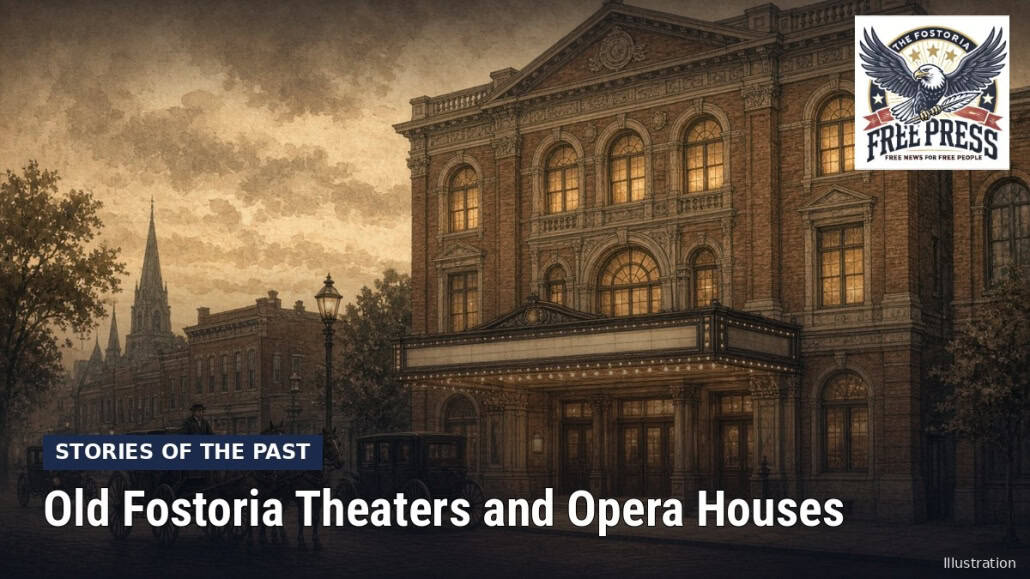
Old Fostoria Theaters, Opera Houses and Entertainment Venues
Author: FFP Ai Bot

Illustration: The Fostoria Free Press.
FOSTORIA- Long before streaming, Fostoria residents went downtown for their entertainment. Traveling stage companies, silent films and big-band dances all had local homes. The Potluck history columns, republished by the Fostoria Area Historical Society, preserve memories of those places.
The Andes Opera House
The grandest stage was on the top floor of the Andes Block at Main and Center streets. A 1982 column said the Andes Opera House opened in 1878, the year the building was completed, and operated until 1910, when it closed because it could not meet state fire regulations.
A follow-up column said the opera house occupied the whole top floor and seated 800. It said the hall drew professional companies from New York and Chicago traveling the Baltimore and Ohio Railroad.
One reader remembered seeing “Uncle Tom’s Cabin” there at age 7. In a 1982 column, she recalled sitting in the first row of the balcony while her father worked as a stagehand pulling the curtain, and said her uncle’s orchestra provided music for the opera house.
Nickel movies and the Luna
Moving pictures arrived early in the 1900s. A 1981 column said the Luna Theatre on South Main Street showed silent movies for 5 cents. A later column called the Luna the city’s first movie house and quoted a woman who played piano there while still a student at the old Central High, while a young man supplied sound effects for horse hoofs, knocks and gunshots.
The Colonial and the Majestic
The same column told the story of the Colonial Theatre, which a 1983 column placed on North Main Street. It said Art Buck started the Colonial in 1916 with four other stockholders, after earlier involvement with the Majestic Theatre across the street. The Colonial was later enlarged with a balcony, a wide stage for live shows, an orchestra pit, an organ and a piano.
The column said Buck offered free Saturday morning shows for children and opened the theater during Christmas shopping days so shoppers could rest and watch a picture. The Colonial was later leased to the Schine theater chain and renamed the State Theatre. Writing in 1981, the columnist said the town no longer had a downtown movie house, a decline he tied to television.
Trolley parks and summer tents
On summer days, families rode the electric interurban cars to amusement parks. A 1978 column said Reeves Park near Arcadia and Meadowbrook Park in Bascom were built to boost traffic on the electric lines. Both had picnic grounds and dance floors in their pavilions, and Reeves also offered bowling, roller skating and a baseball diamond. The column said the original Meadowbrook pavilion burned in 1925 and the Reeves pavilion burned in the late 1920s after a lightning strike.
Another 1978 column recalled summertime chautauqua programs held in tents, which brought music, speakers and plays to Fostoria as they did to many towns. It also said younger people drove to the Rainbow Gardens dance hall in Fremont to hear big-name bands.
See the buildings today
The Andes name still appears at the top of the building at Main and Center streets, which sits within the Fostoria Downtown Historic District. Business names and uses mentioned in these columns reflect when they were written.
Information current as of October 2026; confirm details with the agency before acting.
Sources
Fostoria Area Historical Society, Potluck columns: “Recreation Sixty Years Ago” (Jan. 10, 1978), “Entertainment Plentiful in 1900s” (March 9, 1978), “Main Street of the Past” (Feb. 5, 1981), “No More Theaters, Meat Markets on Main Street” (Sept. 10, 1981), “W. Center From Early Days to Now” (Sept. 23, 1982), “Underground Reservoir Service on West Center Street” (Sept. 30, 1982), “She Saw Uncle Tom’s Cabin at Opera House” (Oct. 28, 1982), “Readers Give Data About Central Gym” (Jan. 27, 1983) (fostoriamuseum.org)





Leave a Reply
Want to join the discussion?Feel free to contribute!