


Source: DC Cline | Hometown History
In the mid‑1960s, Fostoria got one of those storybook small‑town moments when the circus rolled right down South Main Street. Residents lined the sidewalks between Eagle and Clark Streets as elephants, wagons, performers, and trucks made their way through town in a colorful parade, the kind of spectacle that briefly turned an ordinary day into something kids and adults would talk about for years. Long before social media or big theme parks, a circus parade like this was a major event, and families planned their day around catching a glimpse of the animals and the big top rolling past familiar storefronts.
From South Main, the caravan headed out toward Zeller Road, where the traveling show set up its tents on the edge of town, transforming open ground into a temporary village of canvas, lights, and music. For many Fostoria residents, that march from downtown to the show grounds marked the beginning of a weekend of cotton candy, acrobatics, and daring acts under the big top. Today, when people share old photos of the parade route and the circus making its way toward Zeller, they’re not just remembering a performance—they’re recalling a time when the whole community came out to the curb to watch the circus quite literally come to town.


The City of Fostoria is reminding residents to stay off frozen reservoirs as temperatures fluctuate this winter. Even when ice appears thick and solid, changes in air temperature, wind, and water movement can create hidden weak spots that are impossible to see from the surface. Unlike a small pond, a reservoir often has varying depths and currents that prevent uniform ice formation, meaning one step can be safe and the next can send you crashing through into frigid water.
Falling through reservoir ice is especially dangerous because you can be pulled under by the powerful suction of intake pipes and underwater flows. Openings near dams, spillways, or intake structures can create strong currents beneath the ice, dragging a person away from the hole they fell through and making rescue far more difficult. Anyone near reservoirs is urged to admire them from the shoreline, keep children and pets off the ice, and call 911 immediately if they see someone in distress.

Neighbors’ concerns about Bell’s Stables have intensified after a detailed whistleblower post on the “Nosy Neighbors of Findlay” Facebook group alleged ongoing neglect, repeated complaints to authorities, and retaliation against those who speak up.


In the days after reports of a dead horse found behind Bell’s Stables on Sixth Street sparked public outrage, a longtime boarder and frequent visitor came forward online to say the incident is part of a larger pattern at the self‑care boarding facility.
Posting under her own name in the Nosy Neighbors of Findlay group, the whistleblower said she has firsthand knowledge of conditions at the barn and personally knows many boarders who she says “take excellent care of their horses,” but insists “at least 6 horses” owned by one individual are not being fed or cared for properly. Allegations of neglect and inadequate response
The post describes multiple attempts over “the past couple months” to get help for the horses, including repeated calls and in‑person reports to the Humane Society that the whistleblower says went unanswered.
According to her account, law enforcement ultimately showed more concern than local animal‑welfare officials, but when the Humane Society did become involved, she claims the owner was given a five‑hour heads‑up before an inspection, allowing time to clean stalls and “bring in feed and hay.”[Screenshot-2026-01-29-at-11.29.56-PM.jpg]
She further alleges that excuses about the cost of hay, lack of adequate feed, and delays in securing veterinary care were offered instead of concrete steps to improve the horses’ condition, even after others offered advice on where to buy hay and how to get better prices.
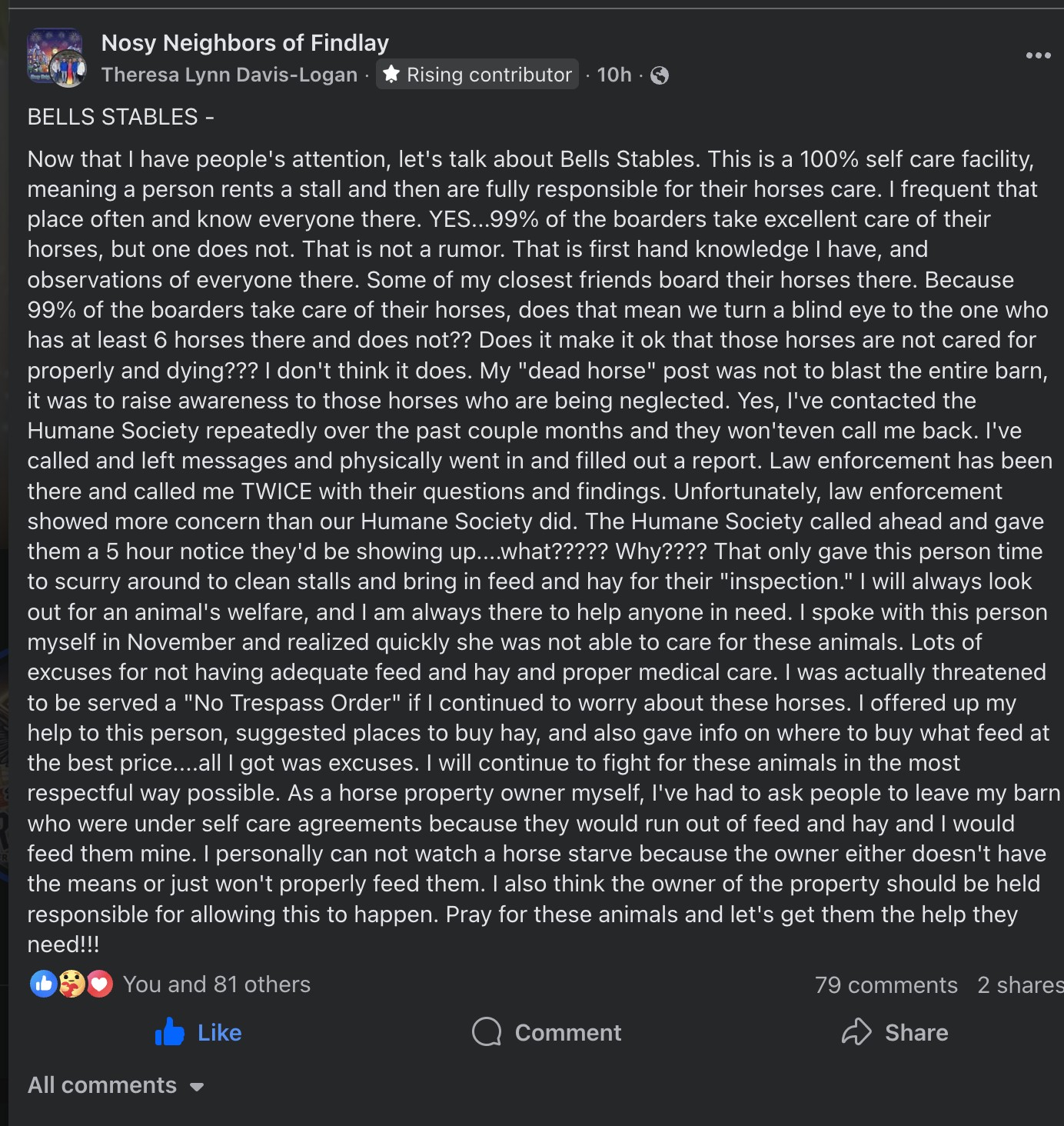
The whistleblower says that after repeatedly raising alarms about the horses’ welfare, she was threatened with a “No Trespass Order” if she continued trying to check on the animals.
She notes that, as a horse owner herself, she has previously asked people to leave her own property when they failed to provide feed and hay under self‑care agreements, arguing that property owners have a responsibility to intervene when animals are clearly not being cared for.[Screenshot-2026-01-29-at-11.29.56-PM.jpg]
In her view, not only the horse owner but also the property owner of Bell’s Stables should be held accountable for allowing alleged neglect to continue on the premises. Community reaction and calls for accountability
The new claims quickly drew dozens of reactions and comments, with many posters expressing anger, disbelief, and sadness over the idea that multiple horses may have been struggling long before the dead animal behind the stable forced the situation into public view
Some commenters stressed that most boarders at Bell’s Stables are doing everything they can for their animals, while others argued that any facility allowing even a handful of horses to go without adequate feed, hay, or vet care should face serious scrutiny.
The whistleblower says she will “continue to fight for these animals in the most respectful way possible” and urges the public to “pray for these animals” while pushing authorities to take stronger action.
Given that at least two horse deaths connected to Bell’s Stables have now been publicly discussed within roughly six weeks, concerned residents are asking whether current complaint procedures, inspection practices, and enforcement tools are sufficient to protect horses at self‑care boarding barns in Findlay and Hancock County.


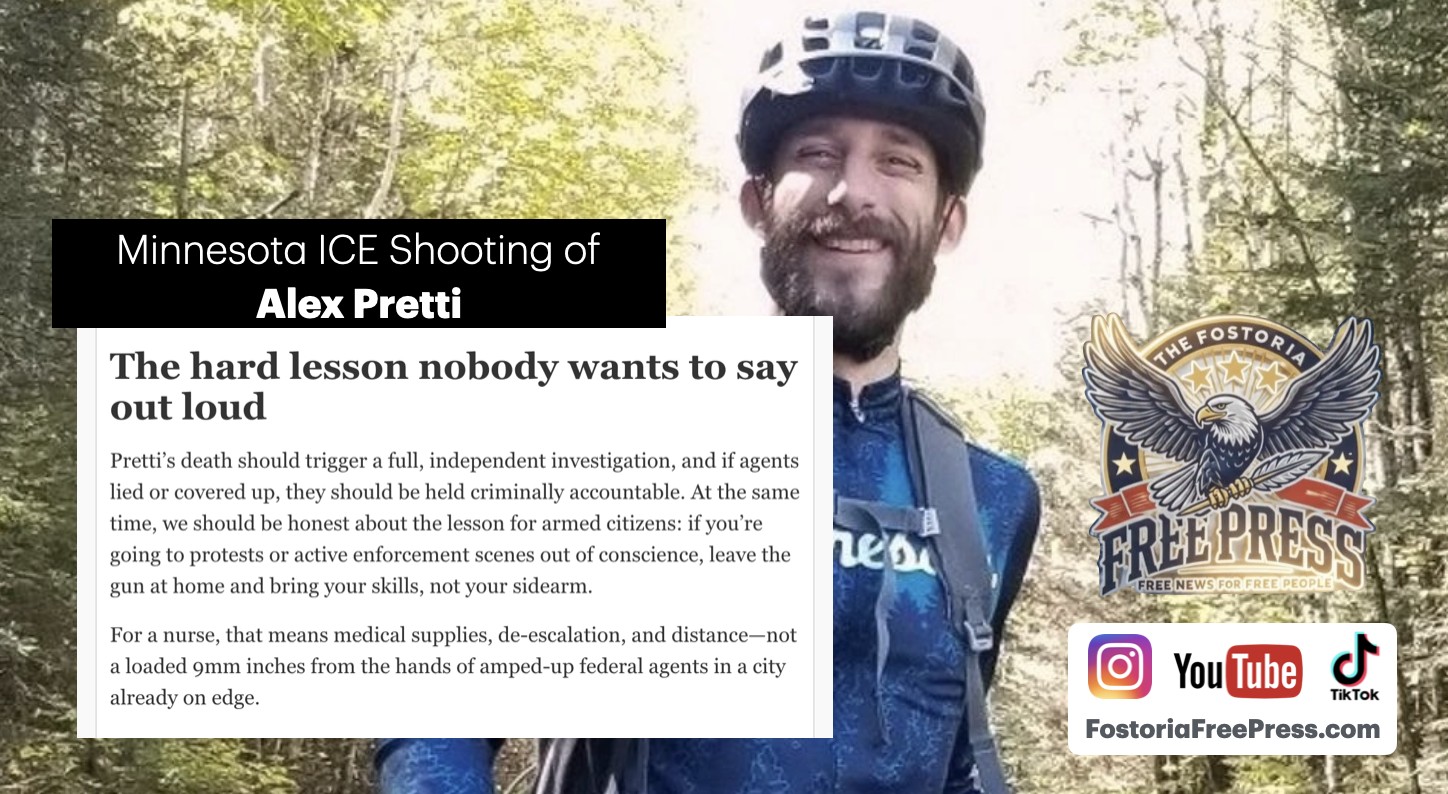
Alex Pretti’s killing has rightly provoked outrage and demands for truth, but one uncomfortable fact keeps getting buried: he still chose to show up armed, with a loaded handgun, in the middle of an active ICE/Border Patrol operation. That decision was legal under Minnesota’s carry laws, yet from a judgment and risk standpoint it was reckless—and tragically helped create the conditions for exactly the kind of catastrophe he was protesting.
According to a New York Times article. NTY claims “Videos analyzed by The New York Times appear to contradict federal accounts of the shooting.”
Federal officials initially claimed Pretti “approached agents with a gun” and “violently resisted,” portraying the shooting as a clear-cut case of self‑defense. But synchronized videos analyzed by major outlets show him holding a phone in his right hand and raising his left as agents grabbed him, with a pistol only produced from his waistband after he was already on the ground, moments before at least 10 shots were fired in about five seconds. A CBP report to Congress acknowledges two agents fired their weapons but does not claim Pretti reached for the gun, and a Minnesota judge has issued an order to preserve all federal evidence amid state concerns about obstruction.
Pretti was by all accounts a dedicated ICU nurse, a lawful gun owner with a permit, and had no criminal record. None of that changes the core reality that he brought a loaded concealed handgun into a volatile protest scene directly around armed federal agents conducting an immigration crackdown. In an environment where agents are already keyed up about ambushes, agitators, and “armed threats,” a citizen inserting himself within arm’s reach of officers while armed—even legally—is almost guaranteed to be interpreted in the worst possible light the second anything gets chaotic.
Supporters frame him purely as a Good Samaritan stepping in to protect a woman from pepper spray, but the optics matter: to the agents, he was an unknown male, at close range, during a tense enforcement action, with a sidearm tucked at his waist. When you choose to walk into that situation with a gun, you are not just exercising a right; you are adding another lethal variable into a scene where split‑second misreads already get people killed.
What makes this even harder to defend is Pretti’s profession. He wasn’t just any bystander; he was a trained ICU nurse who had just watched his city absorb one federal shooting and was well aware tension was sky‑high. If his primary mission was to protect and help people, why was the tool he brought to the front line a pistol, not a trauma kit?
A critical care nurse showing up with tourniquets, chest seals, gloves, and a clearly marked medic bag would still be taking a risk—but it would send a completely different signal to everyone there. Protest medics operating in other cities have learned to make themselves as visibly non‑threatening as possible: no concealed weapons, high‑visibility markings, and distance from direct confrontations whenever they can. Pretti, by contrast, arrived as a dual‑identity figure—healer by training, armed civilian by choice—and that ambiguity proved lethal once bodies started colliding and hands went to holsters.
In the Second Amendment debate, people love to stop at “it was legal.” Legality is a floor, not a standard of wisdom. It was legal for Pretti to carry; it was also, in context, a profoundly bad idea to exercise that right in the tight orbit of ICE/Border Patrol operations he knew were already under fire for use of force.
That doesn’t excuse the agents’ actions; the video evidence and conflicting federal accounts raise serious questions about whether they escalated, misperceived, or outright overreacted when they opened fire on a man who appeared to be holding a phone. But it does complicate the narrative of pure martyrdom. When you strap on a gun and step into the hottest part of a federal operation, you are making a choice that amplifies the danger for yourself and everyone around you, no matter how noble your intentions.
Pretti’s death should trigger a full, independent investigation, and if agents lied or covered up, they should be held criminally accountable. At the same time, we should be honest about the lesson for armed citizens: if you’re going to protests or active enforcement scenes out of conscience, leave the gun at home and bring your skills, not your sidearm.
For a nurse, that means medical supplies, de‑escalation, and distance—not a loaded 9mm inches from the hands of amped‑up federal agents in a city already on edge.


*Not financial advice. This is an Ai overview:
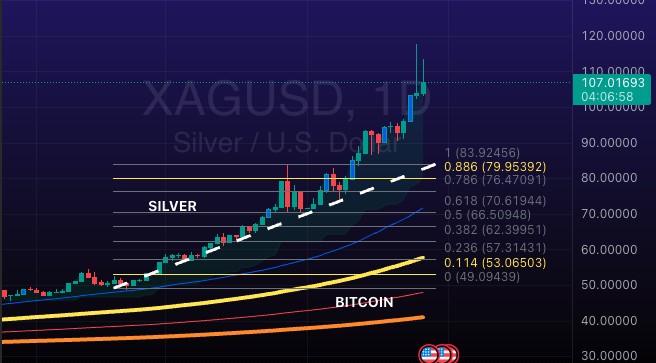
Silver has already entered a sharp bull phase in 2025–26, but most credible outlooks still frame upside in terms of high double‑digits to low‑triple‑digits per ounce rather than the most extreme four‑figure targets.
Silver has broken to record territory, trading in the low‑$100s per ounce after a roughly 150–200% surge over the past 12–13 months. Recent reports cite spot prices around 110–120 dollars, with one outlet noting a move through 117 dollars on January 27, 2026 amid strong yearly gains. This rally follows a historic run in 2025, when silver first pushed through 80–90 dollars and then accelerated as supply deficits and speculative interest intensified.
Analysts highlight a cluster of structural and macro drivers rather than just short‑term speculation. The most cited forces are:
Persistent supply deficits: Silver has run multiple years of mine‑supply shortfalls, drawing down above‑ground inventories and tightening the physical market.
Industrial demand: Solar, electric vehicles, electronics and AI‑related hardware are materially increasing silver’s industrial usage, making it both a monetary and high‑tech metal.
Monetary backdrop: Global rate‑cut cycles, weaker real yields and a softer dollar reduce the opportunity cost of holding bullion and tend to support precious‑metal prices.
Geopolitics and de‑dollarization: Geopolitical tensions and central‑bank diversification out of dollars into bullion add a “risk and currency” premium to both gold and silver.
Together, these conditions help explain why silver has overshot many earlier forecasts that expected it to remain below 100 dollars in 2026.
Mainstream houses and precious‑metal specialists now generally cluster their 2026–27 silver expectations between about 90 and 170 dollars, with upside tails above that. Examples:
| Source / View | Stated or Implied Range | Context |
|---|---|---|
| UK‑based bullion firm outlook | 90–120 dollars as a core 2026 band, with upside cases to 150–170 dollars if deficits and retail demand persist. | Sees current prices as elevated but fundamentally supported. |
| Industry commentary (Metals Focus, others) | Averages in the 50–60 dollar area in earlier drafts for 2026, but now acknowledge risk of moves “well north of 100” as price action has broken records. | Earlier, more conservative forecasts that have been overtaken by events. |
| GoldSilver.com analyst | Expects silver to trade “above 100” in 2026 after a 147% gain in 2025, with tight supply and strong industrial momentum. | Emphasizes consolidation punctuated by upside spikes. |
| Large bank “bull case” | Bank of America has referenced a possible 170‑dollar scenario within roughly two years, noting that recent gains have overshot prior expectations. | Treated as an upper‑bound bull case, not a base case. |
More aggressive voices go further: some commentators and high‑profile investors have floated 100–200 dollars per ounce by early 2026 or shortly thereafter, and certain long‑term technical models talk about very long‑range targets in the 300–400‑dollar zone. These numbers, however, sit at the speculative end of the spectrum and depend on extended deficits, continuing monetary debasement, and sustained investor mania.
Algorithmic and retail‑driven forecast sites occasionally publish paths where silver reaches over 1,500 dollars by the end of 2026 and nearly 3,000 dollars by 2030. While mathematically possible in a severe monetary or geopolitical crisis, such paths imply additional 10–20× moves from already elevated levels, far beyond anything seen in modern bullion history.
Several reasons make these extreme outcomes less “realistic” in a base‑case sense:
Mean reversion: Parabolic moves in commodities tend to invite substitution, recycling, hedging and position‑clearing, which cap price blow‑offs.
Policy response: Very high silver (and gold) prices often coincide with tightening financial conditions or regulatory interventions, which can cool speculative froth.
Industrial demand elasticity: At some point, manufacturers redesign products to thrift silver or switch inputs if prices stay too high, softening demand.
Because of these mechanisms, many research notes warn that sharp corrections or volatility spikes are likely even if the long‑term trend remains upward.
Putting current data and published forecasts together, a pragmatic working thesis for “how high silver can realistically rise” in this bull run would be:
Base‑to‑bull range: 90–150 dollars per ounce as a plausible 2026 trading band, assuming ongoing deficits, strong industrial demand and supportive monetary policy.
Stretch targets: 150–170 dollars in an extended bull scenario where physical tightness intensifies and investor flows remain strong.
Speculative tails: 200‑plus dollars and especially four‑figure prices should be treated as low‑probability, crisis‑type outcomes rather than central expectations.
For a piece titled “2026 Silver Bull Run – How High Can Silver Realistically Rise?”, you could frame it around that 90–150‑dollar core range, discuss the 150–170‑dollar “stretch” zone, and then contrast those with the much more speculative 200‑plus and four‑figure narratives.
