
FOSTORIA | “Fostoria’s Most Awful Tragedy”: The 1903 Cane Factory Explosion
Author: FFP Ai Bot
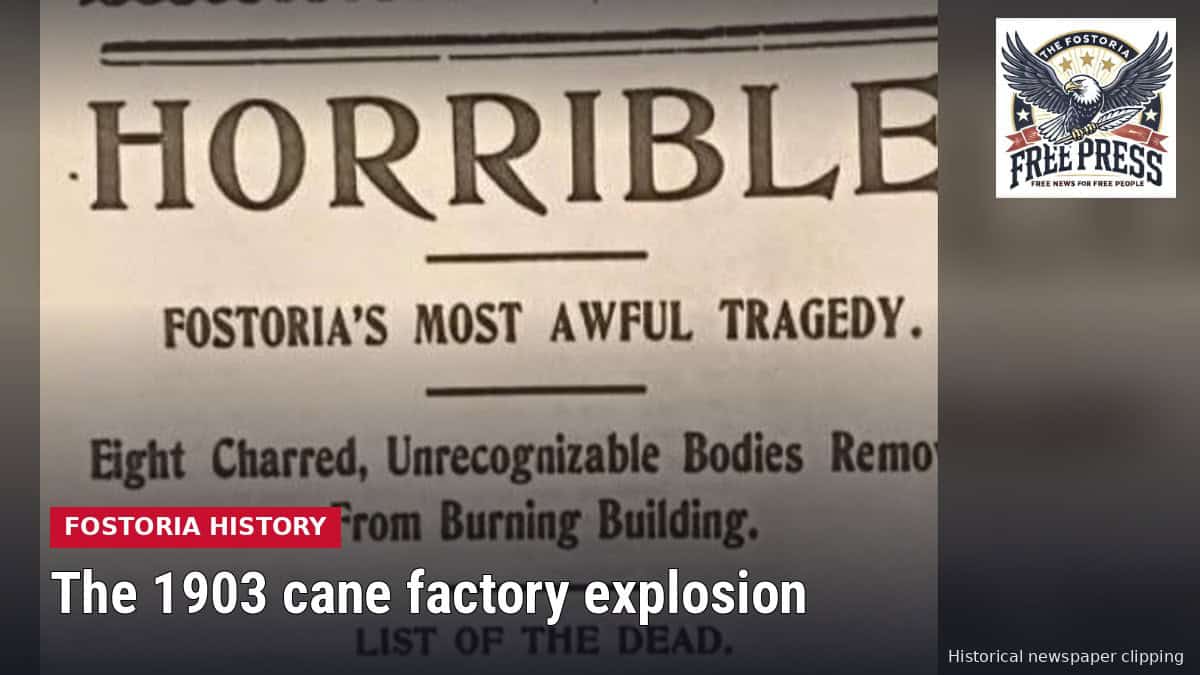
Local newspaper report of the explosion, February 1903
FOSTORIA — “HORRIBLE! Fostoria’s Most Awful Tragedy.” That was the headline a Fostoria newspaper ran in February 1903, after an explosion tore through a small factory on South Main Street and killed eight people. The paper called it “probably the worst accident in the history of Fostoria.” More than 120 years later, it is still one of the darkest chapters in the city’s history.
This installment of our local history series looks back at the disaster using the local clipping shown here and wire reports printed in newspapers across the country, now preserved by the Library of Congress.
Quick timeline
| Date | What happened |
|---|---|
| Early 1903 | A factory on South Main Street, just north of the B&O tracks, makes the explosive used in the Fox Magazine Cane. |
| Mon., Feb. 16, 1903 | About 1 p.m., an explosion and fire destroy the building. Eight people die. |
| Feb. 16-17, 1903 | Wire reports of the disaster run in newspapers from Maine to Alabama. |
| Spring 1903 | The family of one young victim leaves Fostoria for Benton Harbor, Mich. |
A cane that went bang
A magazine cane was a walking stick fitted to fire caps, making a loud report, a popular novelty of the era. According to the local report, the building belonged to Mrs. Reidel and stood “just north of the B. & O. on South Main street.” It was occupied as a factory for the explosive used in the Fox Magazine Cane, run by Robert L. Short, who made the explosive under contract to Fox & Peter, the cane’s manufacturers.
A wire story printed Feb. 17, 1903, in the Portland (Maine) Daily Press described “the Peter and Fox magazine cane factory” as holding “a large supply of high explosives used in the manufacture of caps for magazine canes.”
One o’clock Monday afternoon
The explosion happened at about 1 p.m. Monday, Feb. 16, 1903. The local paper reported that Short had been hurt and blamed a new fanning mill that had recently been put into use on an experimental basis. As the reporter understood him, Short noticed heat or some sign that the chemicals were about to ignite and threw a bucket of water on the mixture. Instead of putting out the beginning fire, it was followed by a flash, and the force of the blast threw him through a window.
The paper described a small building with four exits, but said the fire spread so fast that only three people got out, all of them badly burned. Many of those inside, it reported, apparently struggled with a door that opened inward. The bodies were found together near that door.
Rescuers fought to reach the victims. The wire story said the dead and injured were carried out on sleds to makeshift hospitals, and the factory was a total loss. The local paper complained that help was slow. Snow-covered streets made it “impossible for the fire teams to make any speed,” and telephone messages went out to doctors, but none arrived until after the bodies had been carried out. (See our companion story on Fostoria’s horse-drawn fire department.)
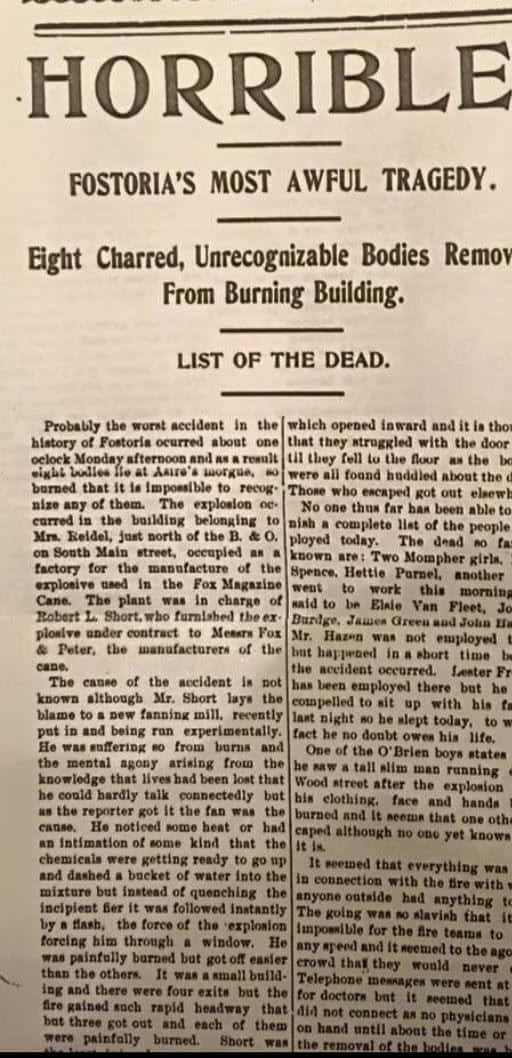
The local report of the explosion and the list of the dead, February 1903
The dead
The bodies were taken to the Asire morgue. The local paper listed the dead known at that time as two sisters, whose name it printed as Mompher (wire reports spelled it Murphy); Elva Spence; Hettie Purnell; Elsie Van Fleet; Joseph Burdge; James Green; and John Hazen. The paper noted that Hazen did not work there, but had stopped in a short time before the explosion. The wire report put the toll at eight dead and four injured.
The same paper told of one employee who had been kept home that morning to sit up with his sick father, a turn of fate the reporter said “no doubt owes his life.”
Hettie Purnell was 16, the daughter of Benjamin and Mary Purnell, who had been publishing religious writings in Fostoria. According to the World Religions and Spirituality Project, the family left Fostoria after her death and in 1903 founded the Israelite House of David colony in Benton Harbor, Mich.
What we could not confirm
The local paper said the cause was not known, and we found no record of a later official finding. Spellings of several names differ between the local and wire reports. Readers with family records of the victims, or a photo of the South Main Street site, are welcome to share them with us.
The disaster came in the middle of Fostoria’s gas boom, when the town was full of glass works and small factories. For more local history, see St. Wendelin: 175 Years of Church and School and The “Hidden Tunnels” Beneath Fostoria. The wire coverage can be read in the Library of Congress’s Chronicling America collection.
Photo note: Photographs and images published before 1931 are in the public domain in the United States. Historical images in this article are shared for educational and historical purposes.
Sources
- Fostoria newspaper, “HORRIBLE! Fostoria’s Most Awful Tragedy,” February 1903 (clipping shown above; published 1903, public domain)
- Portland Daily Press (Portland, Maine), Feb. 17, 1903, p. 2, “Eight Killed: Explosion in Magazine Cane Factory,” via Library of Congress, Chronicling America: https://www.loc.gov/resource/sn83016025/1903-02-17/ed-1/?sp=2
- Kingston Daily Freeman (Kingston, N.Y.), Feb. 16, 1903, “Eight Lives Lost”: https://news.hrvh.org/veridian/?a=d&d=kingstondaily19030216.2.56
- World Religions and Spirituality Project, “Mary’s City of David”: https://wrldrels.org/2024/07/18/marys-city-of-david/










Leave a Reply
Want to join the discussion?Feel free to contribute!